What Is the Cost Structure for Building My Client Acquisition System with The Speed Scaling Group?
Aug 13, 2026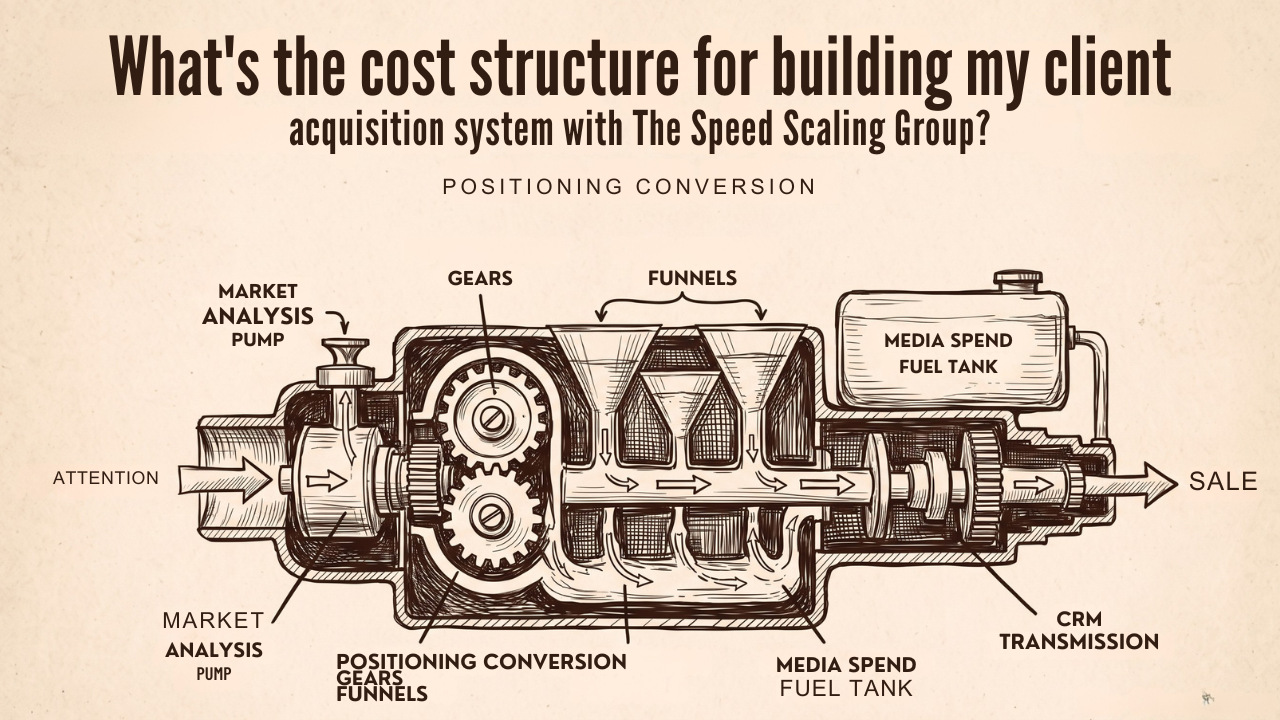
By Fred Smith, The Speed Scaling™ Group · Updated August 14, 2026
Building a client acquisition system with The Speed Scaling™ Group isn't the same as buying ads, hiring an agency, or purchasing another piece of software. You're building an economic system designed to turn attention into qualified prospects, prospects into sales conversations, and sales conversations into customers.
Your total investment can include strategy, positioning, messaging, funnels, advertising, technology, sales infrastructure, implementation, testing, optimization, and media spend. The exact cost depends on what already exists, what must be built, your market, your sales economics, and how aggressively you want to scale.
The better question is this: what is unreliable client acquisition already costing you?
The expensive part usually isn't building the system

When client acquisition is unpredictable, the leaks add up fast.
It's 2:17 on a Tuesday afternoon. Your laptop is open. Stripe is open. Your CRM is open. Your calendar is open. And there're too many white spaces where appointments should be.
You refresh. Nothing. You check email. Nothing. You open your ad dashboard. Money went out. You open your CRM again. A few leads came in. One entered a fake phone number. Another downloaded something three weeks ago and disappeared. Someone booked a call and didn't show.
Your salesperson says the leads suck. Your media buyer says sales isn't following up fast enough. Your marketing person wants another landing page. Your consultant wants a new offer. Some guy on YouTube says you need a VSL. Someone on LinkedIn says funnels are dead. Another person says AI agents will replace your sales department by Christmas.
Meanwhile... payroll is still Friday.
That's the failure. Not because your business necessarily lacks demand. Not because you are stupid. Not because your offer automatically sucks. The failure is that customer acquisition has become unpredictable.
And unpredictability gets expensive fast.
You don't have a lead problem. You have a system problem.
A business can survive an ugly logo. It can survive a mediocre website. It can survive an embarrassing Instagram account. What becomes much harder to survive is not knowing where the next ten customers are coming from.
That uncertainty infects everything.
You hesitate to hire because you don't know whether demand will be there. You hesitate to expand because you don't trust the pipeline. You discount because cash needs to move. You tolerate bad-fit customers because revenue is revenue.
You chase referrals. You buy another lead list. You switch agencies. You change offers. You rebuild the website.
You start posting every day. You stop posting every day. You hire an appointment setter. Fire the appointment setter.
Buy software. Cancel software.
And after enough of this, the company begins resembling a garage filled with expensive exercise equipment.
Lots of stuff. No coherent system.
That distinction matters. A client acquisition system is not a collection of marketing tactics. It's the connected infrastructure that moves a stranger through a deliberate sequence: attention, interest, qualification, conversation, sale, follow-up, measurement, improvement.
If one section breaks, money leaks. If several sections break, you can spend more money and actually make the situation worse.
The invisible cost of random client acquisition

Marketing without your numbers is driving through fog with the headlights off.
Suppose you sell a $10,000 service. You need ten new clients this month. That means you need $100,000 in new revenue.
Sounds simple. But now work backward.
- How many qualified sales calls does it take to produce ten customers?
- How many booked appointments does it take to produce that number of completed calls?
- How many qualified leads create those appointments?
- How many visitors create those leads?
- How much does each visitor cost?
- What percentage of leads are contacted?
- How quickly?
- How many receive follow-up? For how long?
- Where do prospects disappear?
That's client acquisition economics. Until you know those numbers, marketing can feel like driving at midnight through heavy fog with the headlights switched off.
You know the engine is running. You hear the tires. You feel the steering wheel. Money is burning. But you can't clearly see what's 200 feet ahead.
This is why the cost of building a client acquisition system cannot intelligently be reduced to, "how much do you charge for marketing?"
That's like asking a contractor, "how much does a building cost?" What building? A shed? A dental office? A 40-story hotel? What's already there? What's broken? What's the land worth? What must the structure accomplish?
Scope follows the outcome. So does cost.
What are you actually paying to build?
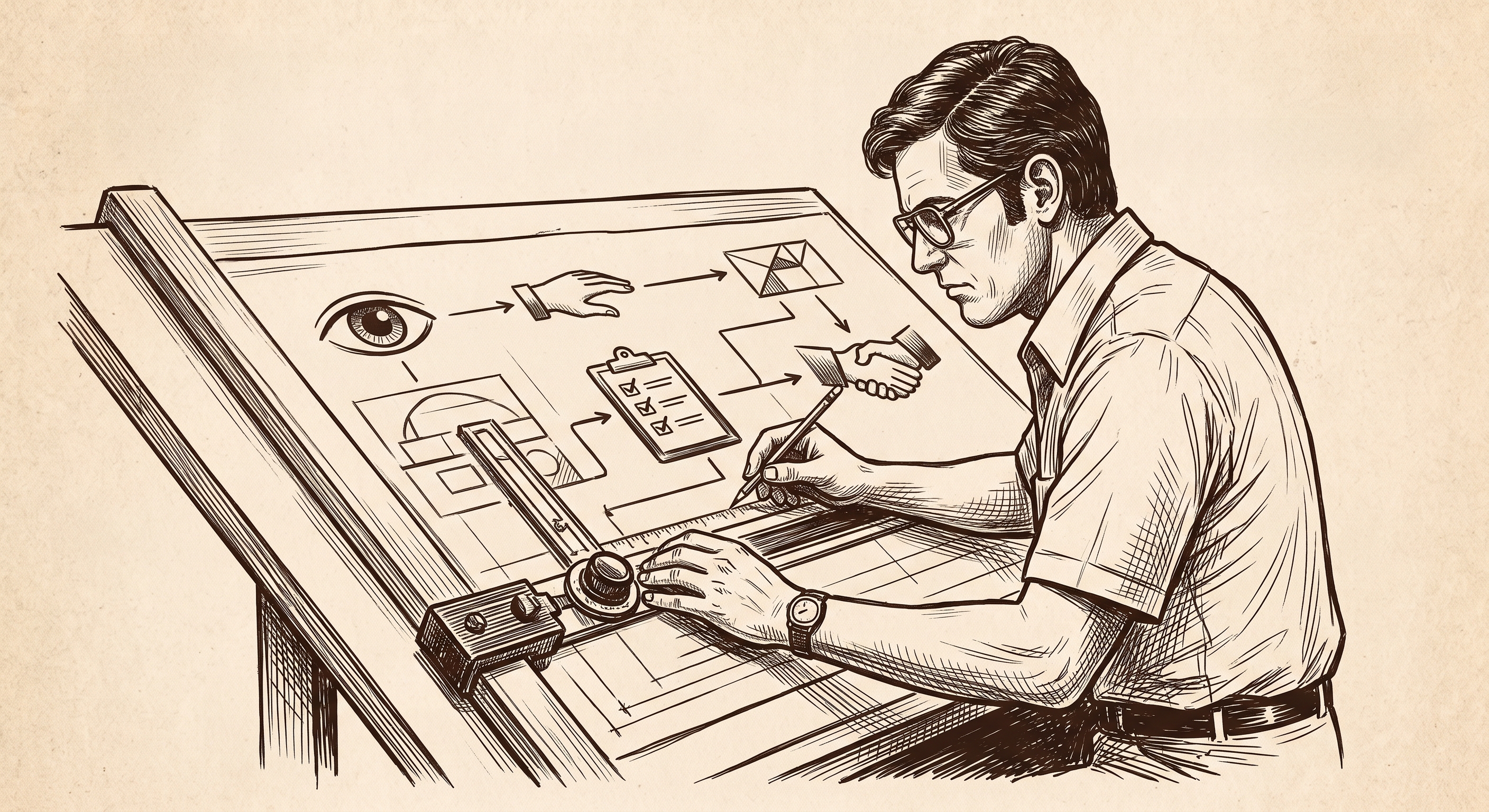
A client acquisition system is engineered, not guessed.
This is where most agency explanations become suspiciously foggy. Let's remove the fog. A serious client acquisition system generally contains several economic layers.
1. Market and economic analysis. Before touching ads, funnels or automation, somebody needs to understand the business.
That includes questions such as:
- Who's the economically valuable customer?
- What are they already trying to buy?
- How urgent is the problem?
- What alternatives are they considering?
- What's the average transaction value?
- What's gross margin?
- What's lifetime customer value?
- How long is the sales cycle?
- What percentage of qualified conversations close?
- How much can you rationally afford to acquire a customer?
This is where a $100 lead can be either horrifically expensive or absurdly cheap. If a customer produces $300 in gross profit, paying $100 for a lead may be disastrous. If one new customer produces $40,000 in gross profit and one out of ten qualified leads becomes a customer, the economics look entirely different.
Cost without economics is trivia.
2. Positioning and offer architecture. Traffic doesn't rescue an offer the market doesn't understand. More traffic simply lets more people misunderstand it faster.
Your acquisition system therefore needs a clear answer to several questions:
Why you? Why this? Why now?
Why should I believe you? Why should I act instead of continuing to shop?
This is where positioning, offer structure, proof, differentiation, risk reduction and message clarity matter. The objective is not clever advertising. The objective is making the buying decision easier to understand.
3. Conversion assets. Now we build the places where interest becomes action. Depending on the business, that can include:
- landing pages
- sales pages
- application pages
- lead forms
- booking pages
- video sales letters
- advertorials
- email sequences
- SMS follow-up
- retargeting assets
- sales presentations
- case studies
- FAQs
- objection handling
- tracking infrastructure
You may already own some of these. Some may be usable. Some may need repair. Others may be actively hurting conversion.
That's why The Speed Scaling Group shouldn't quote every company as though each business arrived in the exact same condition.
You don't need another pile of assets. You need the right assets connected in the right order.
4. Traffic and media. Then comes traffic. Google Ads. YouTube. Meta. LinkedIn. Search. Retargeting. Content. Organic discovery. Referral traffic. Whatever channels make economic sense for the specific market.
And here's an important distinction: media spend is not the same thing as the cost of building or managing the acquisition system.
Advertising dollars are the fuel. The acquisition infrastructure is the engine, transmission, instrumentation and steering.
Putting more fuel into a badly tuned engine doesn't fix the engine. Sometimes it just produces a more expensive cloud of smoke.
5. CRM, automation and follow-up. This is one of the least glamorous, and potentially most valuable, parts of the machine. A prospect raises their hand. Then what? Does someone respond in 30 seconds? Five minutes? Tomorrow?
Does the lead receive email? SMS? A phone call?
Does someone know whether the prospect watched the video? Opened the email? Booked? Canceled? No-showed? Requested information? Went silent?
Most businesses obsess over generating the lead and treat everything after the lead like administrative cleanup.
That's backwards.
The money is often sitting in the follow-up. Your technology costs can therefore include CRM software, communication systems, scheduling, tracking, attribution, automation and integrations.
These are recurring operating costs, not magic. AI can improve speed and leverage. It can't make bad economics good.
What happens if you keep doing what you're doing?
This's the uncomfortable part. The market isn't waiting for you to figure this out. Your competitors are improving. Advertising platforms change. Search behavior changes.
AI changes how buyers research. Cost per click changes. Customer expectations change. Sales cycles change.
And every month you operate without reliable acquisition data creates another month of incomplete information.
Imagine December. Same desk. Same CRM. Same nervous refresh. Except now you've spent another pile of money trying things. Your database is bigger. Your software stack is bigger. Your team is bigger.
Your certainty isn't. That's the nightmare. Not failure. Confusion.
Because when a system fails cleanly, you can repair it. When disconnected tactics produce disconnected data, you may not even know what failed.
So you keep changing variables. New headline. New campaign. New closer. New agency. New funnel. New offer. The business begins responding to yesterday's pain instead of tomorrow's opportunity.
Stop buying marketing. Start building acquisition infrastructure.
At some point, a business owner has to decide: are we experimenting with marketing, or are we building a customer acquisition capability? Those are different decisions.
The first asks, "what should we try?" The second asks, "what must be true for this company to acquire customers predictably and profitably?"
That second question changes everything. Because now you can work backward from the economics.
Desired revenue. Average customer value. Required customers. Required sales. Required appointments. Required leads. Required traffic. Required media. Required conversion rates. Required follow-up.
Now marketing stops being a box of tricks. It becomes engineering. And engineering can be measured.
What should your investment actually buy?
If you're considering The Speed Scaling™ Group, or any serious client acquisition partner, don't judge the investment merely by the quantity of deliverables. Fifty deliverables can still produce zero customers.
Instead, ask what business capability is being created.
You should be looking for greater clarity around your market, your offer, your message, your acquisition economics, your traffic, your conversion path, your sales process, your follow-up, your measurement, and your ability to improve the system.
You should know what you own. You should know what third-party platforms cost. You should know what media spend is separate. You should know which assumptions are being tested.
You should understand which numbers determine whether scaling makes sense.
And nobody can responsibly guarantee a specific financial return simply because you bought marketing. Results depend on factors including your offer, market, pricing, margins, sales ability, implementation, competition, media costs, customer behavior and execution.
That's not a disclaimer designed to weaken the proposition. That's how grown-ups talk about money.
So what does The Client Engine cost?
There are really three buckets of investment to consider.
Bucket one: building the machine. This is the strategic and implementation work required to create or repair the acquisition system. The exact investment depends on the gap between what you currently have and what the business actually needs.
Bucket two: operating the machine. These are recurring costs such as software, CRM, communications, hosting, automation, data and other necessary technology. Your stack should serve the system. The system shouldn't exist to justify your software stack.
Bucket three: feeding the machine. This is your media or traffic investment. It's typically governed by your acquisition economics, market size, objectives and desired speed. A company trying to add a modest amount of monthly revenue should not automatically have the same media strategy as one attempting to add many times that. Speed has a price. So does scale. And so does learning.
The right question isn't, "what's the cheapest way to do this?"
It's, "what level of investment gives us enough data, enough opportunity and enough runway to determine whether the economics work, and then scale what works?"
That's a much more useful conversation.
Imagine knowing the numbers

When you can see the numbers, uncertainty turns into control.
Now picture a different Tuesday. Same desk. Same coffee. Different feeling.
You open the dashboard. You know how many qualified prospects entered the system. You know what you paid. You know how many booked. You know how many showed. You know how many bought. You know the average customer value. You know the bottleneck.
Maybe cost per lead increased 12%. Fine. You can see it. Maybe appointments are healthy but show rate slipped. Good. Now you know where to look. Maybe sales volume is strong but close rate fell. That's not a traffic problem. Maybe conversion is excellent and customer acquisition cost is below target.
Now you have a very interesting problem: how much more can we responsibly put into the machine?
The room hasn't changed. The laptop hasn't changed. But the business feels different. Because uncertainty has been replaced by information. And information gives you something entrepreneurs rarely get enough of: control.
Not perfect control. Markets don't give you that. But enough visibility to make rational decisions.
Enough data to stop guessing. Enough structure to stop rebuilding the company every time a campaign has a bad week.
That's the point of building a client acquisition system.
The most expensive acquisition system may be the one you never build
There's a strange tendency in business. Owners will calculate the cost of action down to the penny. Then treat the cost of inaction as zero.
It isn't zero.
If your company should be acquiring five additional customers per month and each customer is worth $10,000, the missed opportunity isn't philosophical. It has a number attached to it. Month after month.
And that doesn't mean you should recklessly throw money at advertising. Quite the opposite.
It means acquisition deserves the same financial seriousness you give payroll, inventory, operations and capital investment. Because customers aren't an optional input. Without customers, everything else eventually stops.
The real goal isn't more marketing. It isn't more leads. It isn't prettier funnels. It isn't AI automation for the sake of telling people you have AI automation.
It's a business that can answer a brutally important question with increasing confidence: if we invest another dollar into acquiring customers, what happens next? When you can answer that question with real data, you're no longer gambling blindly. You are operating a system.
Before you spend another dollar on client acquisition, watch this
If you're actively searching for a client acquisition system, comparing marketing agencies, evaluating lead generation companies, researching customer acquisition costs, or deciding how much you should invest to grow your business, don't make the decision based on the cheapest monthly fee. And don't make it based on the biggest pile of deliverables.
Understand the machine first. Understand the economics. Understand what has to be built. Understand what must be measured. Understand what scaling will actually require. Then decide.
I put together a masterclass that walks you through the Speed Scaling™ approach to building a client acquisition system.
If you're in-market now, watch it before you hire another agency, launch another campaign, buy another funnel or put another dollar into ads. Go to the form below, enter your information, and watch the masterclass.
See the system. Understand the economics. Then decide whether Speed Scaling™ Group is the right team to help you build it.
About the author. Fred Smith is the founder of The Speed Scaling™ Group and the creator of The Client Engine and The AEO Formula. A Meritorious Service Medal Marine and a direct-to-consumer marketer since 1993, he builds client acquisition and answer-engine systems for expert-led businesses. No hype, no guru circus. Just the system, one step at a time.
Educational notice: This article is for educational and informational purposes. Any dollar figures used are illustrative examples only, not projections or promises. We make no income or earnings claims of any kind. Any results depend on many factors, including your market, offer, pricing, margins, sales ability, competition, media costs, and execution, and are not typical, promised, or guaranteed. Check with a qualified professional before acting on this or any information.