How to Get Recommended by ChatGPT
Aug 13, 2026
By Fred Smith, The Speed Scaling™ Group · Updated August 14, 2026
You get recommended by ChatGPT by becoming the answer, not by chasing a ranking. In plain terms, that means building entity authority (consistent, verifiable proof of your business scattered across the web: Schema.org structured data, an accurate profile with matching name, address, and phone across the major directories, real reviews, and citations on sources other people already trust) and then publishing content that answers your buyer's exact questions so clearly the model repeats your name back. You stop optimizing for a search bar. You start optimizing for a conversation. That is the whole shift, and most businesses have not started.
Here is the moment that sent you looking for this. Somewhere out there, right now, the exact client you were born to serve leans toward a screen and asks the AI, out loud, "who is the best at this?" The machine answers, calm and certain, and reads three names into the quiet. Not one of them is yours. Not because you are not the best. Because the machine cannot find the proof that you are. That is not a talent problem. It is a findability problem, and unlike talent, findability can be built.
Key Takeaways
- Buyers are already asking AI who to hire. ChatGPT alone crossed 800 million people a week in 2025, according to OpenAI, and that is before you count Google's AI answers, Gemini, Perplexity, and Copilot.
- ChatGPT recommends businesses on entity authority, the internet's collective proof that you are real and trusted, not on how polished your own website copy reads.
- This looks a lot like the early days of search, when whoever showed up first became the default and stayed there. The window to be your category's AI answer is open now.
- Ads and answer engine optimization are two speeds of the same engine. Ads bring buyers today. AEO makes you the answer they get tomorrow.
What is answer engine optimization for businesses?
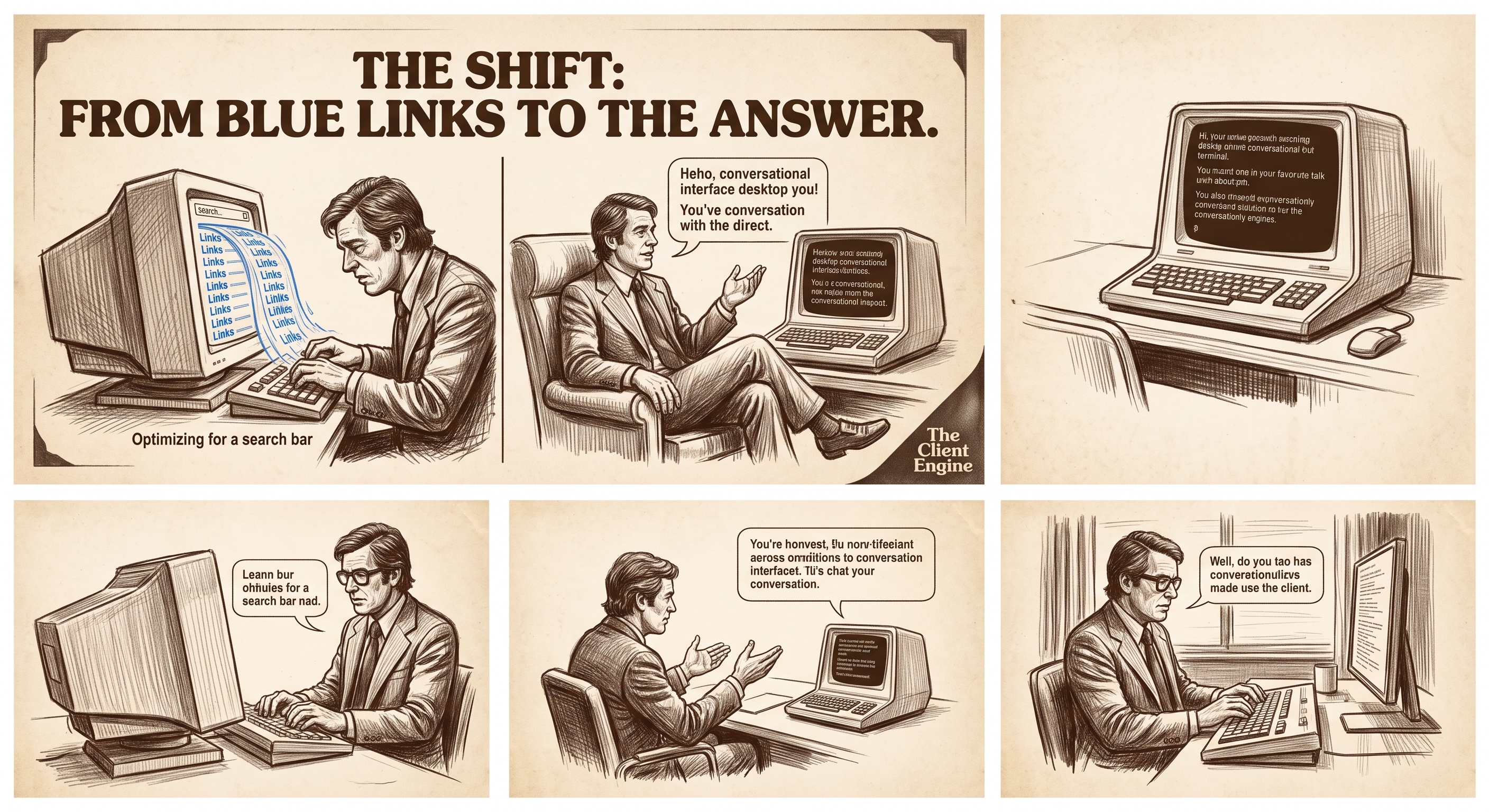
The shift: from a list of blue links to being the answer.
Answer engine optimization (AEO) gets your business found, cited, and recommended inside the AI tools your buyers already trust: ChatGPT, Gemini, Perplexity, and Google AI Overviews. It does not chase a ranking position on a results page. It earns your business a spot inside the actual answer.
Compare that to old-school search. Ranking a link and hoping for a click used to be the entire game. That game has shifted. Now the win is being the answer sitting right there in the conversation, no click required, no competing links beside you. Generative engine optimization (GEO) works alongside AEO to make sure the models understand your expertise well enough to repeat it back as a recommendation.
Here is the distinction worth remembering:
| Traditional SEO | Answer Engine Optimization |
|---|---|
| Produces a list of links | Produces the answer itself |
| Wins a click | Wins the recommendation |
| Optimizes for a search bar | Optimizes for a conversation |
SEO is a list. AEO is the answer. That single line explains why businesses still investing only in old-school rankings keep losing ground to the ones who show up inside the chat window instead.
What do people actually search for when they want to get recommended by AI?
Business owners looking for how to get recommended by ChatGPT usually type close variations: AI search optimization, AI SEO, ChatGPT SEO, or generative engine optimization. Those searches all point at the same goal, getting named as the trusted option when a buyer asks an AI who to hire.
Does AEO replace SEO entirely?
No. AEO builds on the same foundation of credible, well-structured content that search engines have always rewarded. The difference is intent. SEO earns visibility. AEO earns a direct citation inside the answer itself.
How does ChatGPT choose which businesses to recommend?
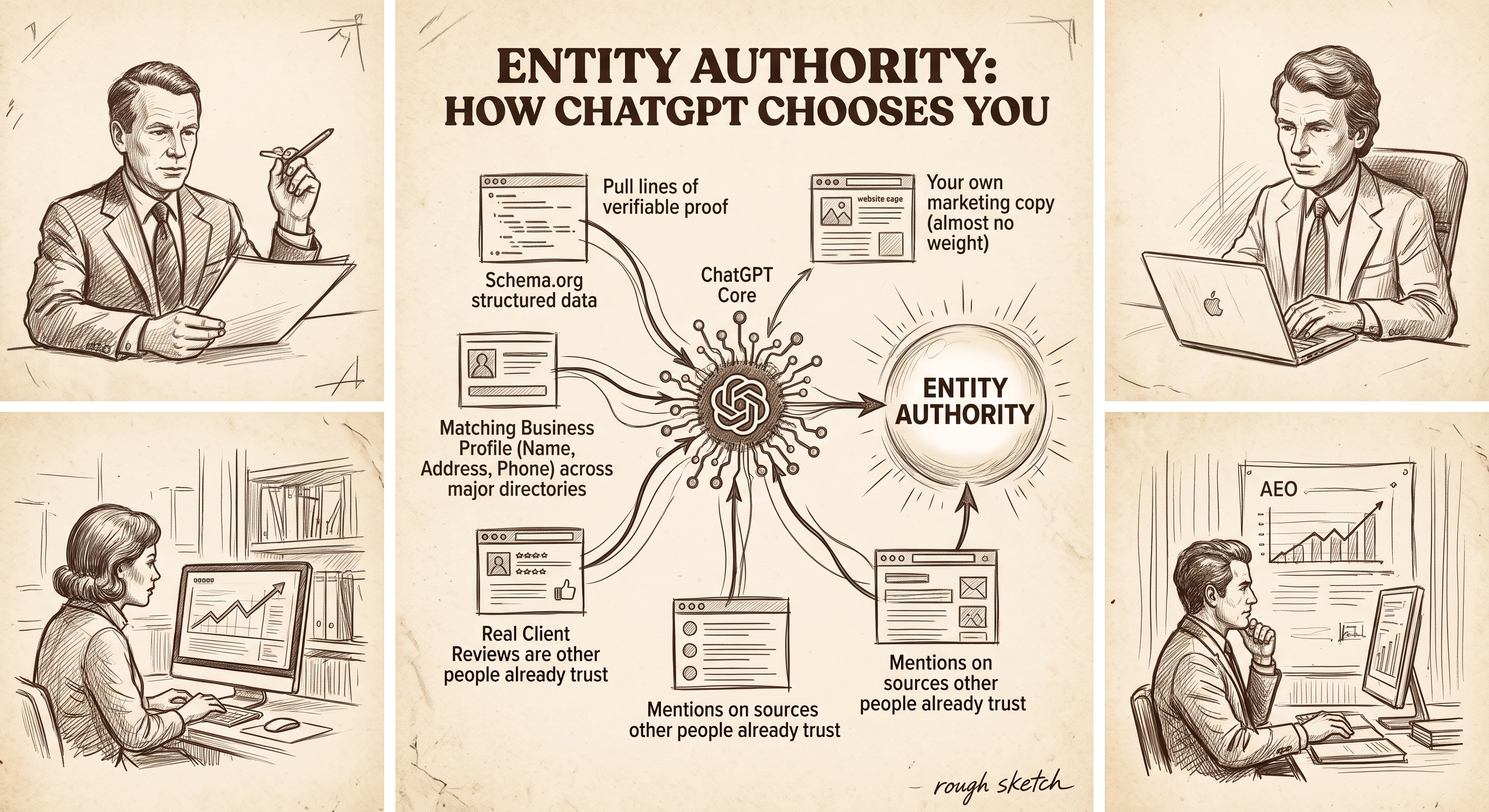
Entity authority: the web's collective proof that decides who the AI names.
ChatGPT recommends businesses on entity authority, not keyword density. Entity authority is the accumulated proof, scattered across the web, that a business is real, credible, and trusted by others. Get this wrong and you stay invisible no matter how polished your website looks.
Here is the shift most owners miss. AI engines like ChatGPT, Gemini, and Perplexity do not crawl your homepage and take your word for it. They synthesize the internet's collective opinion of you: reviews, mentions, comparisons, forum threads, press, and third-party sites that talk about your work. Your own marketing copy carries almost no weight in that equation. What other sources say about you carries nearly all of it.
This matters because the behavior underneath it already changed. A real and growing share of buyers now skip the list of blue links and simply ask ChatGPT or another AI who is best in a category, whether that is an AC repair tech or a marketing consultant. And when the AI answers right there on the page, most people never click through to a website at all. Answer engine optimization is the discipline built for exactly that shift: getting your business named, cited, and trusted inside those answers instead of buried in a list.
What does entity authority actually require?
Consistent, verifiable proof of your business across sources you do not fully control: third-party mentions and citations, structured data, real reviews, and content that answers real buyer questions in your specific niche.
Why does a good website not guarantee a ChatGPT recommendation?
A polished website proves nothing to a model on its own. Generative engine optimization treats your site as one data point among many, weighed against everything else the internet says about you.
When a buyer asks the AI who to hire, the goal is simple: your name is the one it says. That is the entire game now, and most businesses have not started playing it.
What criteria should you use to choose an AEO partner?
Ownership separates a real partner from a rented one. Ask a blunt question before you sign anything: does this arrangement build something you keep, or does it rent you leads month to month? Many agencies quietly count on the second model. They keep you hooked on their retainer and their ad account, and the moment you stop paying, the leads stop with you. The right answer engine optimization partner builds a machine you own outright, one that keeps working in your voice long after the contract ends.
Money-first pitches are a warning sign, not a selling point. A partner who leads with promised numbers or guaranteed rankings is selling you a fantasy, because nobody controls how an AI chooses to answer a query. What you can measure is the machine itself: whether the citations exist, whether the funnel converts, whether the automation runs without you standing over it. Judge a partner on built assets, never on projected income.
Does the partner teach you, or just sell you?
A trustworthy partner makes you more capable with every deliverable, not just more excited for a weekend. If your vendor hands over a report you cannot explain to your own team, walk away. Real partners show their work.
Will they handle the whole funnel, not just the ads?
Traffic aimed at a broken landing page is money burned for nothing. Confirm the partner builds the full conversion path, the landing page, the offer, and the follow-up, not just the clicks. That is the real test: does the work end in booked calls, or just impressions?
What content and signals get you cited by AI?
Five signals decide whether AI engines cite your business: semantically complete content, real topical authority, local trust markers, structured answers to buyer questions, and consistency across every platform. Skip any one and you hand the citation to a competitor who did not.
Start with the content itself. Google and every major AI read searchable, semantically complete content to decide who is credible enough to recommend. That means full answers, not thin pages built to trick a keyword tool. Real information gain, structured so both a search bar and a chatbot can find it, is what separates a business that gets named from one that gets skipped.
Does local SEO still matter for AI recommendations?
Yes, and for local and service businesses it matters more than most owners realize. How to get recommended by ChatGPT still leans on strong local fundamentals: detailed service pages, recent five-star reviews, an accurate business profile with matching name, address, and phone, and mentions on the third-party sites your industry already trusts. AI pulls from the same trust signals Google has weighted for years.
What separates AEO from traditional SEO?
AEO is not about ranking a link. It is about being cited as the direct answer, which requires content built around the exact questions your buyers type into AI tools.
Should you run ads, go organic, or both?
Both earn a place in your engine, and each does a different job. Paid ads put your name in front of buyers today. Organic search and answer engine optimization build the recommendation status that makes AI point to you next month, next year, and every year after.
| Channel | Speed | What it builds |
|---|---|---|
| Paid ads (PPC, social, video) | Fast, active | Immediate leads and calls |
| Organic plus AEO and GEO | Slow, compounding | Trust, citations, recommendation status |
Here is the catch nobody tells you before you spend on either one. Ads amplify whatever message sits behind them. If your positioning is fuzzy, more spend just spreads the fuzz farther and faster, at a higher cost per click. Clarity comes first. Everything downstream, paid or organic, depends on it.
Do I need ads if I am already doing AEO?
Usually, yes. AEO and GEO build authority that compounds, but it takes months to mature. Ads fill that gap and keep leads coming while your organic and AI presence catches up.
Is running just one channel a mistake?
Usually. A single tactic in isolation is a leak, not a system. Ads without a clear funnel waste spend. Content without AEO structure gets ignored by the AI your buyers now ask instead of Google.
Right now, almost nobody in most fields has adjusted for how buyers research through AI. That gap will not stay open. The businesses that pair paid traffic with AEO today become the default answer before competitors even notice the ground shifted, and defaults are brutal to unseat once they set.
What does an AEO client engine actually include?
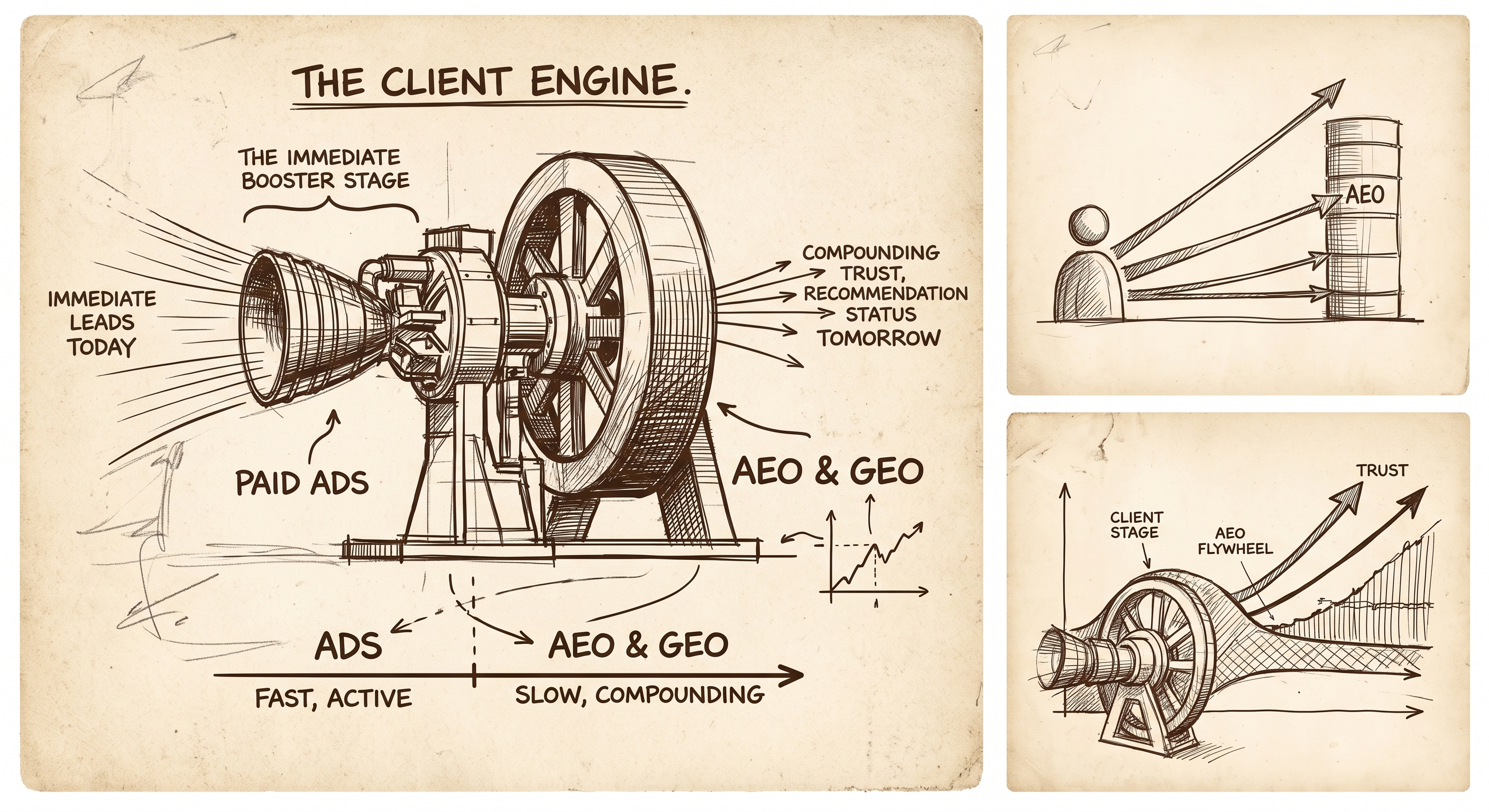
The Client Engine: the four-part machine that makes you the answer.
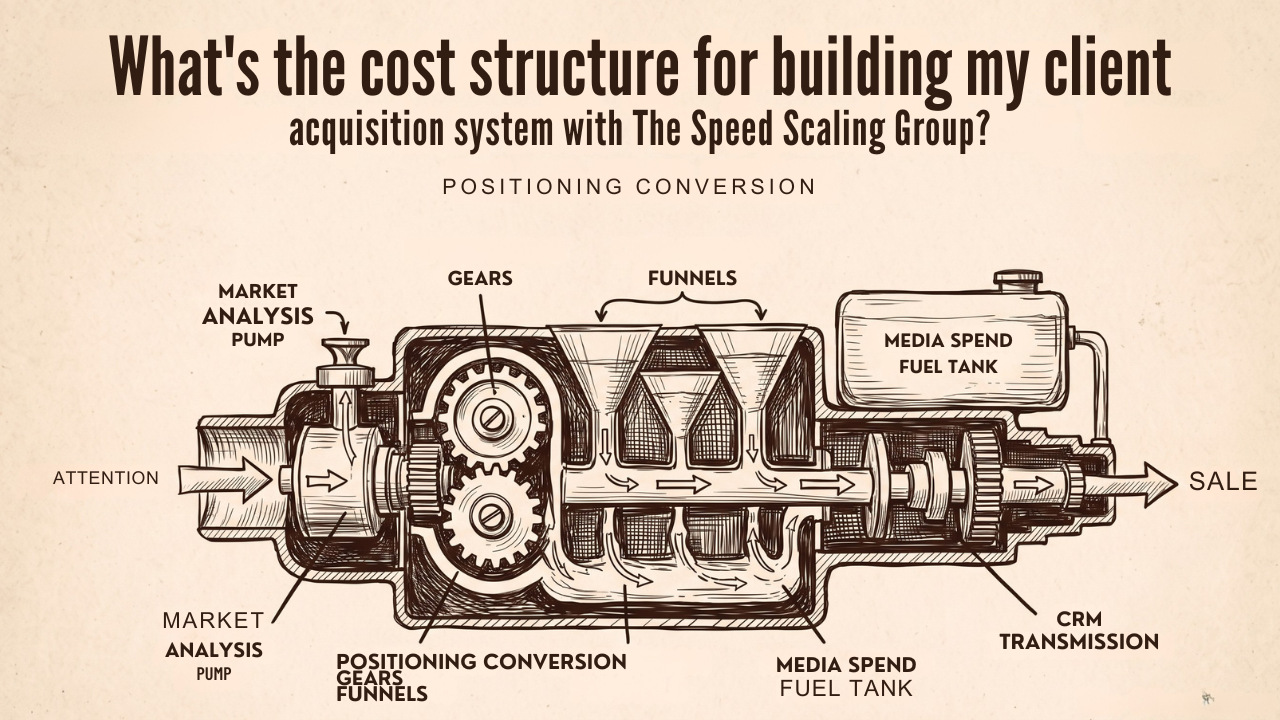
Four parts make a working answer engine optimization system, and each earns its place. Skip a part and the rest starts to leak. This is the Client Engine: a four-part machine built to make the right people find your business and keep running whether you touch it today or not.
The build starts with your North Star. Before any ad runs or any page gets written, you lock the one client you actually serve and the one expensive problem you solve for them. Most businesses skip this and pay for it later, spreading a fuzzy message across five audiences instead of owning one.
How does AEO turn expertise into something AI can find?
Depth alone does not get cited. Your years of hard-won knowledge get translated into a clear, magnetic message, one both a prospect and a large language model can point to when asked who is worth hiring. This is where AEO diverges from old-style content marketing. You are not writing for a scroll. You are writing to be the answer.
From there the machine gets built. Paid ads bring traffic now. A conversion-ready funnel turns that traffic into booked calls. An AEO presence, layered with real GEO, gets you found and cited inside AI tools. Automation follows up so no lead goes cold. And a circle of accountability keeps the whole thing from dying in a folder.
| Layer | Job |
|---|---|
| North Star | Defines who you serve and the problem you solve |
| Message | Makes your expertise legible to buyers and AI |
| Machine | Ads, funnel, AEO presence, and automation, working together |
| Accountability | Keeps the build from dying in a folder |
Learning how to get recommended by ChatGPT means building all four, not chasing one tactic in isolation.
How do you get started becoming the answer?
Start with the free masterclass. In about an hour, in plain English, it walks you through the exact shifts that take a business from invisible to the name the AI says: how buyers actually research now, why findability beats talent, and the simple machine that makes the right people find you and choose you, without posting every day and without becoming a loud self-promoter.
Now picture the other side of it. The same client leans toward the same screen and asks the same question, "who is the best at this?" And this time the machine says your name. Not because you got louder. Because you finally became findable, and the proof was there for the AI to see and repeat. That is what becoming the answer feels like, and it starts with one honest hour.
Register for the Free Masterclass
And a word on standards, because you have been burned before. Nothing we build counts as finished because a video got watched. It counts as done when the asset exists and is live, when it passes a real check, and when it works, meaning it produces a citation, a booked call, or a running campaign. We sell the capability, never a number. That is Transparent Marketing, and it is the whole doctrine.
FAQ
What is answer engine optimization?
Answer engine optimization gets your business found, cited, and recommended inside AI tools like ChatGPT, Gemini, and Perplexity. Instead of ranking a link, it earns your business a spot in the actual answer.
Does answer engine optimization replace SEO?
No. AEO builds on the same foundation of credible, well-structured content that search engines reward. SEO earns visibility, and AEO earns a direct citation inside the answer itself.
How does ChatGPT decide which businesses to recommend?
ChatGPT recommends on entity authority, not keyword density, synthesizing reviews, mentions, comparisons, forum threads, and press from across the web. Your own marketing copy carries almost no weight in that decision.
Do you have to post content every day to become the answer?
No. Becoming findable has nothing to do with posting volume. It is about answering the one question your best client is already typing into a search bar or a chat window, consistently and correctly, until the AI and the buyer both land on the same name: yours.
About the author. Fred Smith is the founder of The Speed Scaling™ Group and the creator of The Client Engine and the AEO Formula. A Meritorious Service Medal Marine and a direct-to-consumer marketer since 1993, he has spent his career inside the systems that decide who gets seen online, and today builds answer-engine and client-acquisition machines for expert-led businesses. No hype, no guru circus. Just the system, one step at a time.
Educational notice: This article is for educational and informational purposes. We make no income or earnings claims of any kind. Any results depend on many factors, including your market, your offer, your effort, and your execution, and are not typical, promised, or guaranteed. Check with a qualified professional before acting on this or any information.